
FAQ
The HD-MG21 is designed for standard miter slots measuring 19mm x 9.5mm (3/4" x 3/8"). It includes adjustable expansion rings on the miter bar to ensure a zero-play fit.
Yes, provided the machine has a standard U-shaped or T-shaped miter slot. Because the HD-MG21 uses an adjustable miter bar, it is highly adaptable to most stationary power tools.
The gauge supports a range of 0 to 70 degrees in both directions. It features positive stops at common increments (0, 15, 22.5, 30, 45, 60, 67.5 degrees) for rapid, repeatable setups.
Use the included hex key to adjust the white expansion discs located along the miter bar. Turn them clockwise to expand the discs until the bar slides smoothly with no lateral movement.
1. Loosen the main handle. 2. Set the gauge to the 0 degree mark. 3. Use a high-precision square against the miter fence and the body of your saw blade.
The telescopic extension allows you to support longer workpieces. It can be extended to provide a stable reference point far beyond the width of the table saw top.
The HD-MG21 includes a precision flip-stop that slides along the fence. You can lock it at a specific measurement; for individual cuts, simply flip the stop up out of the way.
Yes. The aluminum fence features a standard T-track profile on the front and top, making it easy to bolt on a custom wooden sub-fence for zero-clearance support.
Check for sawdust buildup or pitch in your table saw slot. Clean the slot with a degreaser and apply a dry PTFE-based lubricant or paste wax.
Yes. The expansion discs are designed to be wear items. If they become flattened or damaged over years of use, they can be replaced.
Periodically check the tightness of the pivot bolt and the positive stop pins. Ensure no sawdust has compacted inside the detent holes.
The YL08 is designed to mount directly into standard T-track (approximately 19mm or 3/4 inch wide) on the top of your table saw fence.
Yes, provided your fence has a top-mounted T-slot. If your fence does not have a T-slot, you may need to attach a sacrificial wood fence with an integrated T-track.
The guides are adjustable in height, but they work best on fences at least 75mm (3 inches) tall to allow for the vertical adjustment range of the guide arms.
The YL08 features one-way roller bearings. The rollers move freely as the wood is pushed forward but lock instantly if the wood attempts to move backward.
The rollers are made of a high-grip, non-marring urethane. They provide significant downward pressure to prevent chatter and lifting without indenting or scratching.
Yes. Because the guides mount to the fence rather than the table, you can position them to hold down narrow strips.
You should adjust the guide height so the rollers are compressed slightly (about 2-3mm) when the workpiece passes under them.
For the best results and maximum safety, it is recommended to use both. The first roller secures the wood before it reaches the blade.
Yes. If the rollers become worn over time or lose their grip due to extreme dust accumulation, the roller assemblies can be replaced.
Over time, fine dust or resin can build up on the urethane. Simply wipe the rollers with a cloth dampened with denatured alcohol or a mild degreaser.
Ensure no sawdust has entered the internal bearing housing. A quick blast of compressed air usually clears the mechanism.
Unlike gauges that rely on a friction lock or simple holes, the HD-TB01 uses a CNC wire-cut gear rack. This one tooth, one angle design ensures that each of the 70 available angles is mechanically locked.
The gear system provides a physical positive stop at every 1-degree increment. For even finer work, it features a scale magnifier lens.
The main body is CNC-machined from 6061-T6 aluminum alloy, while the indexing pins and gears are made of hardened stainless steel and brass components.
The standard HD-TB01 is designed for a 19mm x 9.5mm miter slot. Specialized versions are available for DeWalt, Bosch, and Festool.
Yes. The head of the miter gauge features standard mounting holes designed to accept most aluminum T-track fences or custom wooden sacrificial fences.
The horizontal compensation allows you to adjust the fence so it sits perfectly perpendicular to the table saw top.
Yes. The magnifying lens is mounted on a sliding bracket. It can be moved for better visibility or removed entirely.
The bottom of the gauge head features quick-positioning detents for the most common woodworking angles (0, 22.5, 45, and 67.5 degrees).
Because the gear teeth are exposed, avoid using grease or oil. Use a dry PTFE spray or keep the teeth clean with a stiff nylon brush or compressed air.
This is usually caused by fine dust buildup inside the indexing mechanism. Use compressed air to blow out the gear area.
The fence is constructed from heavy-duty 6061-T6 aluminum alloy, CNC-machined for straightness.
The HD-KS22 features a telescoping design. Its base length is 500mm, but it can be extended up to 850mm.
No. The fence features a dual-scale system. The laser-etched markings are precisely aligned regardless of extension length.
While it is the native partner for the HONGDUI HD-TB01, its back-side T-slot design allows it to be mounted to many other miter gauge heads.
The fence slides onto the mounting bracket of the miter gauge head via the rear T-slot and is secured with the provided knobs.
Yes. The front face of the HD-KS22 features an integrated T-track. You can easily bolt on a wooden sub-fence for zero-clearance support.
The flip-stop includes a micro-adjustment screw that allows for fine-tuning with an accuracy of 0.02mm.
Yes. Because the HD-KS22 uses a standard T-track on the top edge, you can add additional HONGDUI flip-stops for complex repeat-cut setups.
1. Set the flip-stop to a specific measurement (e.g., 100mm). 2. Perform a test cut. 3. Measure the resulting piece with a digital caliper and adjust accordingly.
Keep the internal sliding tracks free of sawdust. Periodically wipe the inner rail with a dry cloth and apply a light coat of paste wax.
The HD-KS22 is designed to be adjusted via the mounting bracket on the HD-TB01. Use the horizontal compensation screws to correct any tilt.
The Kerfmaker is a bridge between your workpiece and your saw blade. It allows you to dial in the exact thickness of your saw blade kerf for perfect-fitting joints.
Yes. Different blades leave different kerf widths. You must recalibrate the Kerfmaker whenever you switch blades.
1. Cut a small slot into a scrap piece of wood. 2. Place the Kerfmaker inside the cut and adjust until it fits snugly with no play.
1. Capture the thickness of the wood you want to fit into the groove using the Kerfmaker. 2. Use it as a spacer to set your fence for each successive cut.
The HD-JF06 typically handles workpiece thicknesses up to 50mm (approximately 2 inches).
It is CNC-machined from anodized aluminum alloy with brass hardware for durability and corrosion resistance.
No. It is a universal measuring instrument. You can use it on router tables, miter saws, or even for laying out joinery by hand.
This is usually due to slop during calibration. Ensure that when you calibrate the tool to the saw's kerf, the fit is snug but not forced.
The sliding mechanism is high-tolerance. Do not use oil. Use a dry PTFE-based lubricant only.
Absolutely. It is one of the most popular uses for the tool and works perfectly for half-lap and box joint setups.
The primary difference is capacity. The HD-JF15 features a longer body designed for wider workpieces up to 150mm.
Both tools share the same CNC-machined tolerances. The accuracy depends on your initial calibration to the saw blade's kerf.
Yes. Whether you are using a single thin-kerf blade or a full dado stack, the tool calibrates to whatever width you need.
If a board is wider than the tool's 150mm capacity, the HD-JF15 can still be used as a reference gauge for setting your fence position.
Absolutely. It is highly effective for setting up router table fences for precise groove and rabbet cuts.
Yes. You can use the HD-JF15 to set the start and stop blocks on your fence for perfectly positioned stopped grooves.
Make a test cut in scrap wood, ensure the scrap is flat and square, then verify the fit with a digital caliper before cutting your actual workpiece.
HONGDUI uses a high-micron industrial anodizing process that is highly resistant to wear under normal workshop conditions.
Treat it as a precision measuring instrument. Avoid dropping it and store it in its case or a padded drawer away from moisture.
The Pro version features a captive lead-screw mechanism that keeps the blade held securely in a threaded carrier, preventing it from falling out when the lock is loosened.
The tool uses a micrometric adjustment knob. One full rotation typically moves the blade 1mm, allowing you to dial in depth changes as small as 0.02mm to 0.05mm for final whisper-thin shavings that leave a glass-smooth finish.
The MT-2465 PRO features an upgraded carbide-tipped measuring probe, a larger LCD display with backlight, and an extended measurement range compared to the standard model.
Dennis from Hooked on Wood is known for his rigorous testing of tool precision. HONGDUI collaborated with him to address real-world user feedback, ensuring the square meets the high standards of professional cabinet makers and furniture builders.
The MT-2465 Pro offers a measuring range of 650mm, making it ideal for layout tasks on medium-to-large panels, cabinet sides, and tabletops.
The holes are CNC-positioned with a spacing of 1mm. This allows you to place your pencil tip into a specific hole and slide the square along the edge of your board to scribe a perfectly parallel line.
Yes. The base features a dedicated pivot point. By placing a pin or a small drill bit in the pivot hole and a pencil in one of the measurement holes, you can draw arcs and circles with high accuracy up to the full length of the blade.
Yes, the square is factory-calibrated. However, because the base is detachable for shipping, you should check for squareness upon arrival.
To check: Scribe a line against a straight edge, flip the square over, and see if the blade aligns with your original mark.
No, It can not be adjusted as it is square out of box.
The 1mm holes are optimized for 0.7mm or 0.9mm mechanical pencils. Standard wooden pencils also work well if they are kept sharp.
The markings are high-contrast and etched into the anodized aluminum, meaning they won't rub off easily. Simply wipe the blade with a soft cloth to remove sawdust. Avoid using abrasive pads (like Scotch-Brite) which can dull the anodized finish over time.
Yes, There is Imperial version. The MT-2465 Pro is primarily designed as a metric tool to maintain the highest precision for the 1mm increment holes. For users in imperial-based shops, it remains an excellent tool for parallel scribing and layout where relative measurements are more important than absolute units.
HD38 (Standard): Features a fixed 90-degree aluminum handle. It is designed for rock-solid right-angle layouts and parallel scribing.
HD38V (Adjustable): Features a rotating handle that allows for precision 0-90° angling. It includes a knurled brass knob for positive, drift-free locking at any angle, essentially acting as a high-precision protractor and T-square in one.
Hadfield steel (manganese steel) is used for its superior toughness and shock resistance compared to standard spring steel. It has a hardness of approximately HRC 50 and is finished with a Titanium coating for extreme wear resistance, ensuring the ruler doesn't lose its straightness or surface quality over time.
The HD38 series is available in multiple lengths:
Metric: 200mm, 400mm, 600mm, and 800mm.
Imperial: 8 Inches, 16 Inches, 24 Inches, and 32 Inches.
The Line Master is a modular sliding block that sits on the ruler. It allows for:
Repeatable Marking: Lock the slider at a specific measurement to mark the same distance on multiple workpieces.
Parallel Scribing: Press the slider against the edge of your board and slide the ruler to draw a perfectly parallel line.
Compass/Circle Drawing: The sliders can be used as pivot points for drawing large arcs and circles.
Different colored sliders are often included in longer sets (600mm+) to help woodworkers distinguish between different presets or stops when performing complex layout tasks that require multiple measurements.
The HD38 features dual-scale laser-etched markings on both the front and back of the blade. This allows for clear readability even in awkward positions. The markings are mathematically aligned with the CNC-machined handle to ensure a perfect 90° reference.
Yes. The handle can be detached, allowing the Hadfield steel ruler to be used as a standalone straight edge or for layout tasks where the T-head would be in the way.
For the adjustable HD38V, you can use the laser-etched degree scale on the handle assembly. For critical accuracy, it is recommended to verify the 0° (90° to the handle) and 45° settings with a high-precision engineer's square during your initial setup.
Yes, the titanium coating is highly resistant to corrosion. However, it is still best practice to wipe the ruler down with a dry cloth after use. If you work in a high-humidity environment, a light application of camellia oil or a dry wax will provide extra protection for the exposed steel edges.
If the sliders become gritty or difficult to move, it is likely due to fine sawdust trapped in the track. Remove the slider, blow out the track with compressed air, and wipe the ruler's edge with a bit of denatured alcohol. Avoid using oil on the ruler body, as it will attract more dust.
Body: High-strength die steel (often finished in a signature black coating) for significant weight and stability.
Blades: High-speed steel (HSS), which retains a sharp edge longer than standard carbon steel when working with abrasive hardwoods.
To remove the blade, fully back out the adjustment knob until the threaded carrier releases the blade shaft. When re-inserting, ensure the notch in the blade shaft aligns perfectly with the carrier pin before tightening the locking collar.
Yes. The blade can be mounted in the standard position (facing inward) or reversed (facing outward). The outboard position is essential for reaching into corners or stopped grooves where the tool's body would otherwise prevent the cutter from reaching the end of the cut.
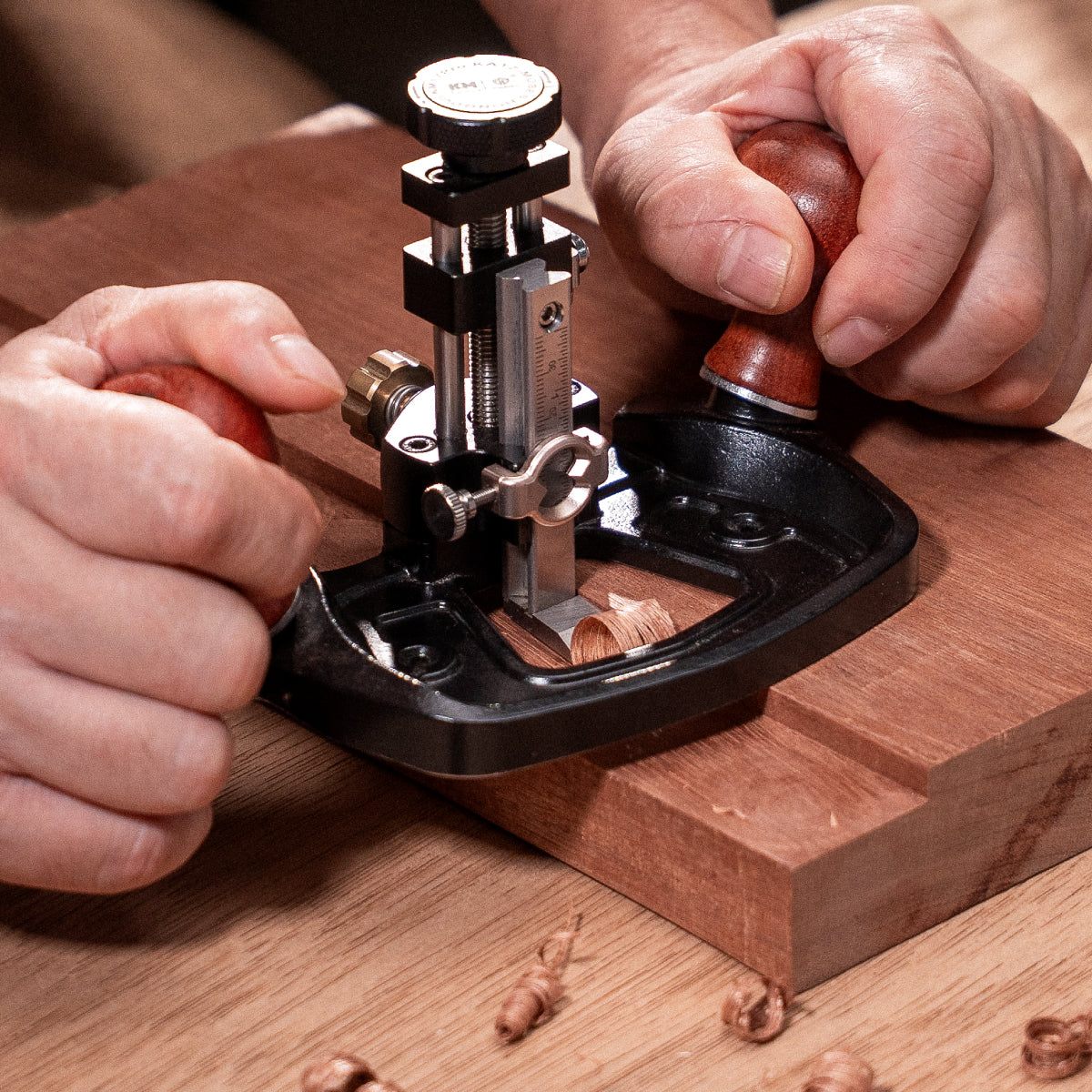
The built-in depth stop allows you to preset a final cutting depth. You can plane progressively deeper until the adjustment knob hits the stop, ensuring that multiple grooves or tenons across a large project are all exactly the same depth.
Because the blades have a removable cutting head, you can unscrew the small hex bolt to detach the cutter from the shaft. This allows you to lap the flat back and hone the bevel on standard sharpening stones much more easily than a traditional L-shaped router blade.
Keep the threads clean of fine wood dust using a stiff brush. If lubrication is needed, use a dry PTFE spray or a light machine oil (like 3-in-1). Avoid heavy grease, as it will attract dust and create a grinding paste that can wear down the precision threads over time.
While the coating provides protection, the machined bottom surface is exposed steel. Periodically apply a light coat of camellia oil or furniture wax to the base to prevent corrosion and help the tool glide smoothly across your workpiece.
This is usually caused by taking too deep a cut or a dull blade. For the best results, set the blade to take a shaving only 0.1mm to 0.2mm thick. If the wood is particularly figured, ensure the locking collar is tightened firmly to eliminate any play in the blade carrier.
Check the two locking points on the fence rods. Ensure the rods are seated fully in the body of the plane. When using the fence, apply pressure to the side of the plane closest to the fence to prevent it from crabbing or pivoting away from your reference edge.
The main body is CNC-machined from 7075 aluminum alloy, which offers superior strength and lightness compared to standard aluminum. The clamping parts are made from 440C stainless steel, ensuring long-term rust resistance and durability in wet sharpening environments.
This is a specialized feature for creating micro-bevels. By turning the eccentric roller, you can slightly lift the angle of the tool without resetting the clamping position. It typically offers three distinct settings:
1. Standard: For the primary bevel.
2.Micro-Bevel 1: For a fine secondary edge.
3.Micro-Bevel 2: For an even finer final polishing angle.
The HD29 features reversible extension jaws that support a clamping range from 0mm to 70mm. This allows it to hold everything from narrow 1/8 Inch chisels to wide plane irons (up to 2-3/4 Inch).
The system includes an integrated quick-positioning tool. By aligning the edge of your chisel or plane iron with the laser-etched markers on the positioning gauge, you can quickly set common angles from 15° to 50°.
No. The HD29 is designed for tool-free operation. It utilizes knurled stainless steel thumb screws that provide enough leverage to lock your chisel or plane iron securely by hand.
The clamping jaws are precision-ground to be perfectly parallel to the roller. As long as your tool's sides are straight and you seat the tool firmly against the jaw shoulders before tightening, it will automatically align square to the sharpening stone.
Yes. The wide roller design provides excellent stability on water stones, oil stones, and diamond plates. The stainless steel roller glides smoothly and prevents the guide from tipping, which is a common issue with narrow-wheeled honing guides.
Yes. The HD29 features a symmetrical design, making it equally comfortable to use regardless of your dominant hand.
The reversible jaws are designed to accommodate various tool profiles. For tapered chisels, ensure you are using the jaw orientation that provides the most surface contact with the tool's sides to prevent pivoting during sharpening.
Because sharpening involves water and metal slurry, it is important to rinse the HD29 under clean water after each use to remove grit. Periodically apply a drop of light machine oil or dry PTFE lubricant to the roller axle to keep it spinning freely.
The 7075 aluminum is anodized for corrosion resistance. However, avoid leaving it submerged in water for extended periods. Wipe it dry after use and store it in a dry place to maintain the precision of the laser-etched scales.
The system is constructed from CNC-machined aluminum alloy and hardened stainless steel. This combination provides the necessary weight for stability while ensuring the tool remains rust-resistant, which is critical for wet sharpening environments.
The HD34 Pro features a modular clamping system and an integrated angle-setting jig. Unlike simple clip-on guides, the HD34 Pro ensures the tool is held perfectly square to the stone through a reinforced bridge structure that eliminates lateral flex.
The system is designed to handle a wide range of tools, from narrow 3mm (1/8 Inch) chisels to wide 65mm (2-1/2 Inch) plane irons. The reversible jaw design allows it to securely grip both flat-ground and tapered (Japanese-style) tools.
The HD34 Pro utilizes a stepped angle-setting block. By sliding the tool forward until it hits the specific stop for your desired angle (e.g., 25°, 30°, or 35°), you lock in the exact projection length required. This eliminates the need for manual measurements or external plastic gauges.
Yes. The HD34 Pro is equipped with a micro-adjustment roller. By turning the eccentric dial on the roller assembly, you can increase the sharpening angle by approximately 1° to 2° without removing the tool from the guide. This allows you to hone a secondary bevel in seconds.
The guide features a self-centering clamping mechanism. As you tighten the knurled brass knobs, the jaws apply equal pressure from both sides, automatically squaring the tool's shank to the axis of the sharpening roller.
The HD34 Pro features a wide, stable stainless steel roller that works perfectly on water stones, oil stones, and diamond plates. Its width prevents the rocking motion that can cause rounded edges on your tools.
Yes. The modular design allows the clamping head to be positioned closer to the roller for specialized or butt chisels that have shorter shanks.
While the HD34 Pro is primarily a honing guide for bevels, its stable reference surface can assist in keeping a tool flat, though most woodworkers prefer to flatten the backs of chisels manually on a stone.
After every sharpening session, rinse the guide under clean water to remove abrasive slurry. Dry it thoroughly and apply a drop of light machine oil or a dry PTFE lubricant to the roller axle and the threaded clamping screws.
The aluminum is anodized to provide a hard, protective surface. However, long-term exposure to water—especially if left sitting in a sharpening pond—can eventually affect the finish. Always store the tool dry.
Ensure no sawdust or metal filings accumulate in the "steps" of the setting jig. Even a small piece of debris can change the projection length and result in an incorrect sharpening angle.
Unlike a standard block plane, the DJ11S is specifically designed to create uniform chamfers (flat bevels) or rounded edges on the corners of your workpiece. Its V-shaped base ensures the tool remains perfectly centered on the edge, eliminating the guesswork of holding a plane at a 45-degree angle.
The body is made from thickened aluminum alloy, providing a balance of durability and lightness for one-handed operation. The blades are crafted from tungsten steel (carbide) or high-carbon steel, designed to hold an edge much longer than standard utility blades.
Yes, the DJ11S features an integrated horizontal bubble level. This helps you ensure that the tool is held perfectly flat during operation, which is especially useful when working on larger surfaces or ensuring consistency across multiple edges.
One of the key features of the DJ11S is its modularity. It typically supports multiple interchangeable cutters:
Flat Blade: For standard 45° chamfers.
Radius Blades: Available in various sizes (e.g., R1, R2, R3) for creating different rounded edge profiles.
Specialty Blades: Depending on the kit, it may include double-rounded or pointed profiles for decorative joinery.
The blades are secured with a single hex bolt. To change them, simply loosen the bolt with the included wrench, slide out the current blade, and drop in the new profile. The tool is designed so that the blades seat in a fixed position, requiring minimal recalibration after a swap.
The DJ11S features a knurled adjustment knob at the top. Rotating the knob moves the blade assembly up or down. Because the blade is held at a fixed angle, this adjustment directly controls the width of the chamfer or the depth of the radius.
The depth is typically adjustable from 0mm to 10mm, though for the smoothest results in hardwoods, it is recommended to take several shallow passes rather than one deep cut.
Once you achieve the desired depth on your first edge, the locking mechanism keeps the blade at that exact height. As long as the knob isn't moved, the V-guide ensures every subsequent edge will be identical.
Tungsten steel blades are extremely hard and difficult to sharpen by hand. However, because they are modular, they are designed to be replaceable. When a blade becomes dull or nicked, most users find it more efficient to replace it with a fresh cutter to maintain precision.
Keep the V-groove base clean of pitch and resin buildup. Periodically wipe the base with a bit of denatured alcohol. Applying a light coat of paste wax to the aluminum base will significantly reduce friction and prevent the aluminum from leaving marks on light-colored woods.
Sawdust can sometimes enter the threaded adjustment column. Use a blast of compressed air to clear the mechanism. Avoid using heavy grease; a dry PTFE spray is the best choice for lubricating the internal threads without attracting more dust.
The standard stainless steel ruler is 200mm long. However, because the sliding body uses a standard-sized track, it can often accommodate longer rulers if your layout task requires a larger radius.
The YH10 serves two main roles:
1.Linear Scribing: Acting as a precision marking gauge to draw lines parallel to a straight edge.
2.Arc/Circle Scribing: Functioning as a heavy-duty compass to draw curves or circles.
The tool is CNC-machined from anodized aluminum alloy with a stainless steel ruler. This ensures the tool is lightweight enough for one-handed use but durable enough to resist rust and wear in a workshop environment.
The tool features a dual-head design. One side of the marking head is flat for referencing against straight edges (Linear Mode). The other side features a specialized dual-roller guide that can follow curved edges or act as a pivot point for drawing arcs.
The YH10 is highly versatile and supports:
1.Tungsten Steel Scriber: For marking permanent, crisp lines on wood, metal, or laminate.
2.Standard Pencil/Lead: The holder is designed to grip a standard pencil or a mechanical pencil for non-permanent layout marks.
The tool features a knurled brass locking knob. Loosen the knob, slide the ruler to your desired measurement using the laser-etched scale, and tighten it. The sliding mechanism is machined to tight tolerances to ensure no "creep" occurs once locked.
Tungsten steel is exceptionally hard and will stay sharp for a long time. If it eventually becomes dull, it can be touched up on a fine diamond stone. Because it is a separate component, replacement tips are also available.
The anodized finish is very durable. Simply wipe it down with a dry cloth to remove sawdust. Avoid using harsh solvents that might affect the laser-etched scale; a bit of denatured alcohol is sufficient for removing sticky wood resin.
This is usually caused by fine dust trapped between the ruler and the aluminum body. Remove the ruler entirely, blow out the channel with compressed air, and wipe the ruler clean. A light application of dry PTFE spray (not oil) will restore a smooth sliding action.
This usually happens if the reference base is not held firmly against the edge of the board. Ensure you are applying consistent lateral pressure toward the workpiece while sliding the tool. For arc work, ensure the pivot point is firmly seated.
Yes. The tungsten steel tip is hard enough to scribe clearly on aluminum, brass, and mild steel, making it a useful tool for both woodworkers and light-duty metalworkers.
The body is CNC-machined from anodized aluminum alloy, providing a lightweight yet extremely durable frame. The scriber utilizes a high-carbon tool steel tip (heat-treated to HRC 58–60), ensuring it can leave crisp lines even in dense hardwoods without dulling.
The HD27 features laser-etched graduations on both sides of the ruler. It allows you to switch between:
Metric: Graduated in 1mm increments (0–130mm range).
Imperial: Graduated in 1/16 Inch increments (0–5 Inch range).
The HD27 includes a retractable "hanging table" or backrest. This is a small platform that can be extended to hook onto the edge of your workpiece, providing a more stable reference point when scribing lines far from the edge.
Yes. One of its standout features is the universal holder.It can accommodate:
Steel Marking Blade: For slicing wood fibers (prevents tear-out).
Steel Marking Needle: For scribing on metal or laminate.
Pencils/Pens: It can hold most standard pencils and pens with a diameter under 11mm.
The front of the gauge features a knurled brass locking nut. Loosen the nut to swap the marking head. The tool-free design makes it easy to switch in the middle of a project without searching for an Allen wrench.
Yes. The profile of the reference base is designed to follow both straight and slightly curved edges. Because the locking mechanism is highly secure, it won't pivot or "creep" while following a contour.
Before starting a project, slide the ruler until the marking tip just touches the reference base. Check if the scale aligns perfectly with the "0" mark. If it's slightly off, you can loosen the scale adjustment screw to recalibrate the zero point.
The HD27 uses a large knurled locking knob on the side of the body. Its high-friction design allows you to lock the ruler firmly with just a half-turn, ensuring the measurement doesn't shift during repetitive marking tasks.
The steel blade is designed to be sharpened. When it becomes dull, you can hone the flat face of the blade on a fine diamond stone or water stone. Do not sharpen the beveled edge unless you are an experienced tool sharpener, as this can change the geometry.
Avoid using grease or oil, as these attract sawdust and can cause the ruler to "bind." Use a dry PTFE-based lubricant or simply keep the ruler clean with a stiff brush and compressed air.
No. The anodized aluminum is highly resistant to corrosion. However, the steel ruler and marking blade can develop surface rust if left in a damp environment. Periodically apply a light coat of camellia oil or furniture wax to the steel components for long-term protection.
The YH07X is primarily designed for 20mm bench holes, which is the standard for MFT-style workbenches (like those from Festool or custom-made MFT tops).
Yes. Most kits include a T-bolt adapter or a specific base that allows the clamp to slide into standard 19mm (3/4 Inch) T-tracks. This makes it versatile for use on drill press tables, router tables, and custom jigs.
The YB07X typically accommodates workpieces up to 70mm to 80mm thick (approx. 3 inches), depending on the specific rod length used. The adjustable arm allows for rapid vertical positioning before locking.
Unlike traditional screw clamps that require multiple turns, the YB07X uses a cam-action lever. You slide the clamping arm down onto the workpiece and then flip the lever. The internal cam geometry applies instant, high-pressure downward force.
While compact, the mechanical advantage of the cam lever can generate upwards of 150kg to 200kg (330+ lbs) of downward pressure. This is more than enough to hold heavy stock during routing, sanding, or hand planing.
The YB07X comes equipped with a non-marring rubber or plastic pad on the pressure foot. This protects delicate hardwoods and finished surfaces from indentations while maintaining a high-grip surface to prevent the wood from sliding.
Yes. Once inserted into a 20mm bench dog hole, the entire clamp assembly can rotate a full 360 degrees. This allows you to position the clamp head at the most effective angle for your specific project.
Yes. There is a tension adjustment screw (usually a knurled nut) on the clamping head. If the lever feels too easy to flip or too difficult to lock, you can fine-tune the tension to achieve the perfect "snap" for your material thickness.
The YB07X is primarily a vertical "hold-down" clamp. However, if your workbench has side-mounted T-tracks or 20mm holes in the apron, it can be used to clamp workpieces against the side of the table for edge-work.
The SC-14 is a "pistol-grip" style quick clamp specifically engineered for woodworking workstations. Its primary role is to secure workpieces to a table or to lock guide rails (like those from Festool, Makita) into place for precise cutting and routing.
The clamp is designed to fit standard 12mm x 8mm T-track slots found on the underside of most professional guide rails. It also fits standard 19mm (3/4 Inch) T-tracks commonly used in homemade workbench tops and drill press fences.
Yes. While the clamp has a T-bolt head, it is frequently used in conjunction with 20mm bench dogs or specialized MFT adapters. It can be inserted from underneath the table through a 20mm hole to pull a workpiece tight against the table surface.
The SC-14 typically offers a clamping range of up to 160mm to 200mm (approx. 6–8 inches) depending on the specific rail length. This makes it ideal for everything from thin veneers to thick 8/4 hardwood slabs.
The SC-14 utilizes a trigger-action lever. You can slide the clamping jaw freely along the rail to close the gap quickly, then pump the trigger to apply final pressure. A dedicated release button allows the jaw to slide open instantly with one hand.
Despite its lightweight feel, the mechanical ratcheting system can generate approximately 60kg to 100kg (130–220 lbs) of pressure. This is optimized for holding workpieces steady without the risk of crushing delicate wood fibers.
Yes. The SC-14 comes with removable soft plastic/rubber pads on both the fixed and moving jaws. These ensure that high clamping pressure does not leave indentations or "bruises" on finished wood surfaces.
The main bar is made of hardened alloy steel to prevent bending under pressure, while the handle and trigger assembly are made of high-impact reinforced nylon and aluminum for a lightweight, ergonomic grip.
Keep the steel bar clean of resin, glue, and sawdust. If the trigger starts to slip, wipe the bar with a bit of denatured alcohol to remove oils. Avoid using heavy grease on the bar; a dry PTFE spray can be used on the internal trigger pivot if it becomes stiff.
This is usually caused by sawdust or wood pitch (resin) buildup on the steel bar. Clean the bar thoroughly. The ratcheting mechanism relies on friction against the bar; if the bar is too "polished" or oily, the teeth cannot grip.
Unlike some generic quick-clamps, the SC-14 is primarily designed for clamping. While some versions allow for the head to be moved to the opposite end, its main engineering focus is as a "pull-down" or "fixing" clamp for guide rails and tables.
The KM-18 features a brass core for concentrated weight and a replaceable nylon/polymer striking face. The brass provides the necessary mass for driving chisels without needing a massive swing, while the nylon face protects your chisel handles and workpiece from marring or mushrooming.
The KM-18 is engineered for "balanced momentum." It typically weighs approximately 22oz. This weight is specifically chosen to be heavy enough for deep mortising but light enough for delicate paring adjustments.
Yes. The striking faces are designed to be consumable parts to save your more expensive tools. You can unscrew the worn head and replace it with a genuine HONGDUI replacement part to restore the flat striking surface.
Like all high-quality brass tools, the KM-18 will develop a natural patina over time. If you prefer the high-luster "red-and-gold" look, you can periodically clean the brass sections with a specialized metal polish and a soft cloth. Avoid getting polish on the wood handle or the nylon face.
The KM-18 features an ergonomically turned wood handle (usually Black Walnut or similar hardwood). While it is securely fitted at the factory for safety and balance, advanced users can technically disassemble the head, though we recommend using the factory handle as it is specifically balanced for the head's center of gravity.
The subtle taper and balance of the head are designed to ensure that the face strikes the chisel at a 90-degree angle during a natural arc of the wrist. This increases accuracy and reduces the chance of the mallet slipping off the end of the chisel.
Ensure the striking faces are fully tightened. Because the mallet is used for impact, the threaded nylon heads can occasionally loosen over long sessions. A simple hand-tightening usually resolves this. If the handle feels loose, contact support before further use.
While primarily a honing and joinery mallet for chisels, the non-marring nylon face can be used to tap joinery together. However, for large-scale furniture assembly, a larger dead-blow or rubber mallet may be more appropriate to avoid focused impact marks on softer woods.
The KM-19 is built with a high-rigidity aluminum alloy frame and a unique lever-action tensioning system. Unlike traditional saws that rely on twisting the handle to apply tension, the KM-19 uses a mechanical lever that provides significantly higher blade tension, resulting in cleaner cuts and less blade "wandering."
Yes, it is compatible with standard 6.5-inch (approx. 165mm) pin-end blades. This allows you to use your favorite third-party blades (like Pegas or Olson) for different materials and tooth counts.
The KM-19 features a 360-degree rotating blade holder. To adjust the angle, you simply rotate the thumb-adjusters at the front or rear of the frame. The indexing mechanism ensures the blade stays locked at the desired angle during the cut.
You should apply enough tension so that the blade emits a "ping" sound when plucked, similar to a guitar string. The KM-19’s lever system is designed to handle high tension, but you should always release the tension lever when the saw is not in use to prolong the life of the frame and the blade.
Over time, fine sawdust can enter the rotating assembly.
1. Release the tension lever.
2. Remove the blade.
3. Clean the rotating hubs with compressed air or a soft brush.
4. Apply a single drop of light machine oil (3-in-1 oil) to the rotating interface. Do not use heavy grease, as it will attract more dust.
Yes, provided you install the appropriate blade. While the KM-19 is a favorite among woodworkers for clearing dovetail waste, its rigid frame makes it excellent for precision work in thin non-ferrous metals and plastics when paired with a high-TPI (teeth per inch) blade.
Frequent snapping is usually caused by one of three things:
1. Over-tensioning: While the saw supports high tension, exceeding the blade's physical limit will cause failure.
2. Aggressive Turning: Trying to turn the saw at too sharp an angle while moving too fast puts lateral stress on the pins.
3. Heat Buildup: In very hard woods, friction can overheat the blade. Slow down your stroke rate and let the teeth do the work.
Check if the blade is properly seated in the pin slots. If the blade is slightly too short or incorrectly positioned, the lever will meet excessive resistance. Never force the lever; ensure the blade pins are fully engaged in the hooks first.